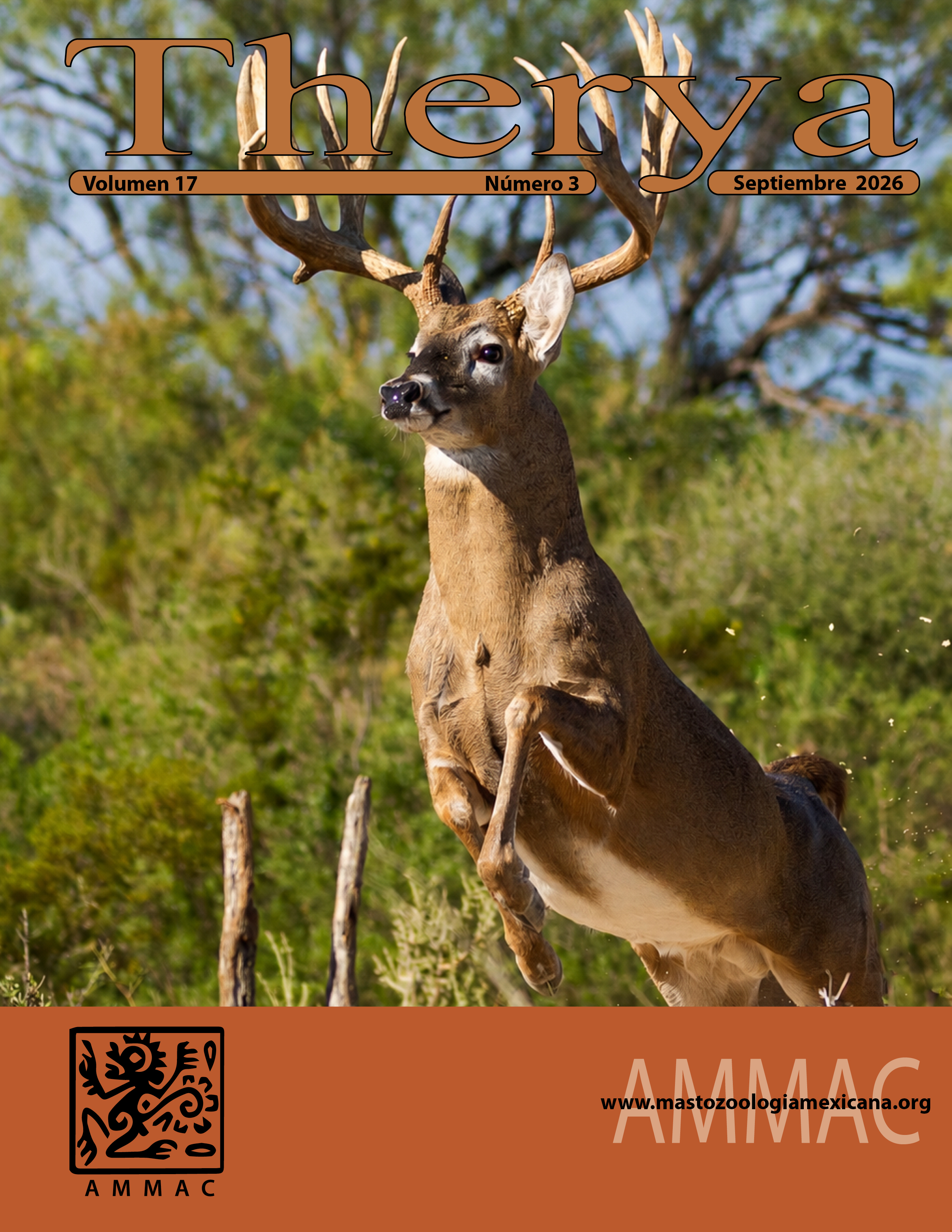
Population density of White-tailed deer in a protected area of the Ecuadorian Andes
DOI:
https://doi.org/10.12933/therya.2026.6250Keywords:
Antisana, Cervidae, Paramo, Population, Line transects, Odocoileus virginianus ustusAbstract
The white-tailed deer (Odocoileus virginianus ustus) is an ecologically important species as it is part of the diet of carnivores and scavengers. However, there is little research on its population density in the Ecuadorian Andes. We evaluated white-tailed deer population density during two consecutive years (i.e., 2023 and 2024) in three different cover types (i.e., shrubland, grassland, and sandy areas) in the Área de Conservación Hídrica (ACH) Antisana. Data were collected by direct observational counts of individuals in line transects of at least 1 km, between 8:00 and 17:00 h. The average population density was 12.61 ind/km-2 in 2023 and 14.25 ind/km-2 in 2024, although these differences were not significant. We also found no differences in deer densities across cover types, although this does not imply a homogeneous distribution of the species in the protected area. There is a clear need for long-term monitoring programs to understand the population dynamics of white-tailed deer and establish management strategies tailored to the unique conditions of each territory. We recommend implementing systematic protocols for estimating white-tailed deer population densities based on direct observation methods, as these provide reliable information on the number of individuals.
Downloads
Additional Files
Published
How to Cite
Issue
Section
License
THERYA is based on its open access policy allowing free download of the complete contents of the magazine in digital format. It also authorizes the author to place the article in the format published by the magazine on your personal website, or in an open access repository, distribute copies of the article published in electronic or printed format that the author deems appropriate, and reuse part or whole article in own articles or future books, giving the corresponding credits.