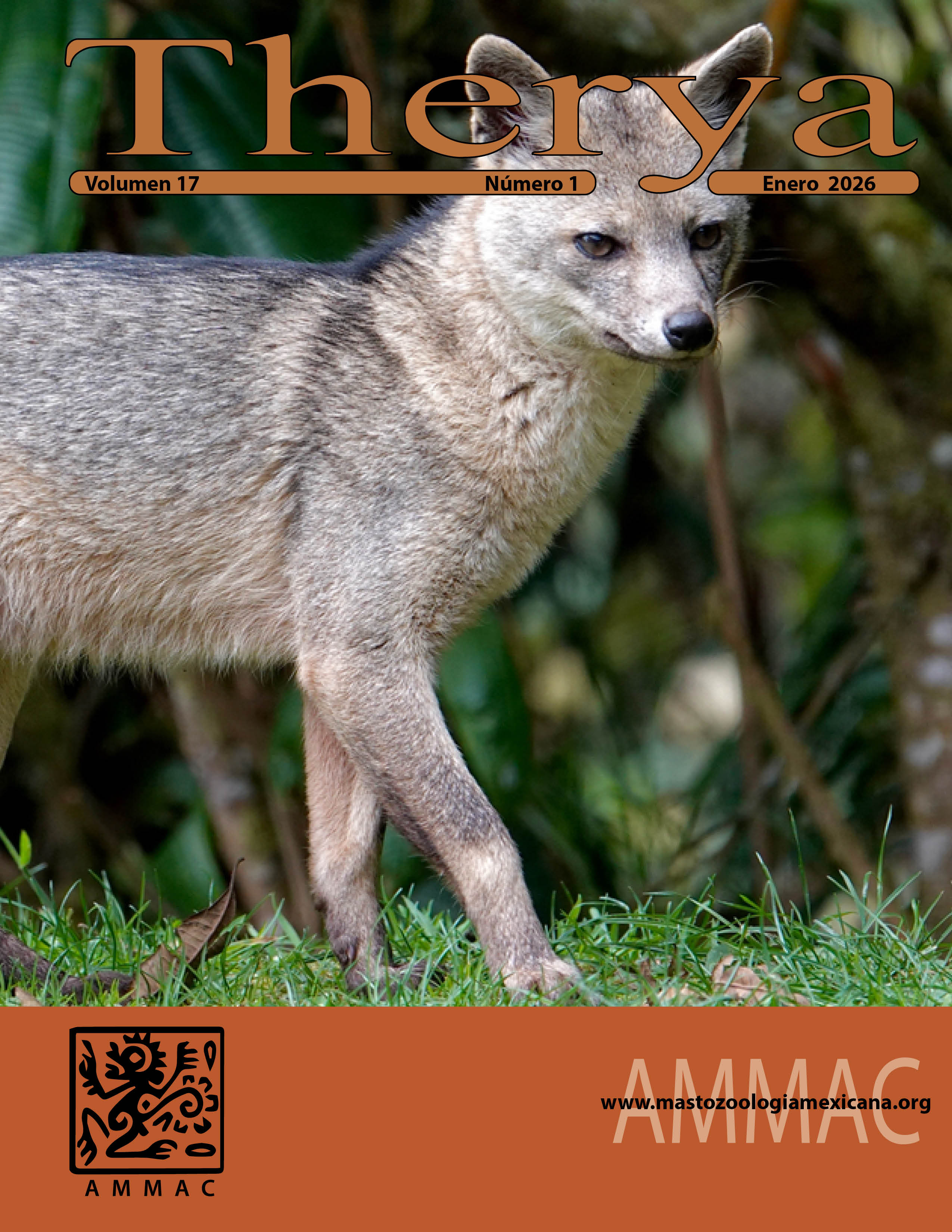
Potential distribution and current records of Neotropical otter (Lontra annectens) in central Mexico
Distribución de Lontra annectens en el centro de México
DOI:
https://doi.org/10.12933/therya.2026.6225Keywords:
State of Mexico, indirect evidence , distribution models , new records, TemascaltepecAbstract
The distribution of the Neotropical otter (Lontra annectens), recently recognized as a separate species after its taxonomic separation from Lontra longicaudis annectens, in central Mexico is poorly known. This study aimed to update its distribution in the State of Mexico using a potential distribution model and field validation to identify priority areas for conservation. The model was generated with the kuenm package in R, incorporating topographical, climatic, and ecological variables. The presence of the species was verified at nine model-predicted sites based on interviews and field trips carried out between April 2024 and March 2025, including expeditions in rivers in the municipality of Temascaltepec. The model predicted an approximate potential distribution of 5300 km of suitable water bodies, representing only a fraction of the state territory. Field validation confirmed the presence of the species in the Telpintla, Grande, and Chilero rivers and documented the Vado River, Temascaltepec, for the first time. Additionally, interviews confirmed its presence in Malinalco and adjacent areas. These findings update the distribution of L. annectens in the State of Mexico and identify areas with high ecological suitability that should be prioritized for its conservation.
Downloads
Additional Files
Published
How to Cite
Issue
Section
License
THERYA is based on its open access policy allowing free download of the complete contents of the magazine in digital format. It also authorizes the author to place the article in the format published by the magazine on your personal website, or in an open access repository, distribute copies of the article published in electronic or printed format that the author deems appropriate, and reuse part or whole article in own articles or future books, giving the corresponding credits.