The genus Habromys: an untold biogeographic history
DOI:
https://doi.org/10.12933/therya.2026.6269Keywords:
Ancestral reconstruction area, cloud forests, Cricetidae, distribution, Mesoamerica, parametric biogeographyAbstract
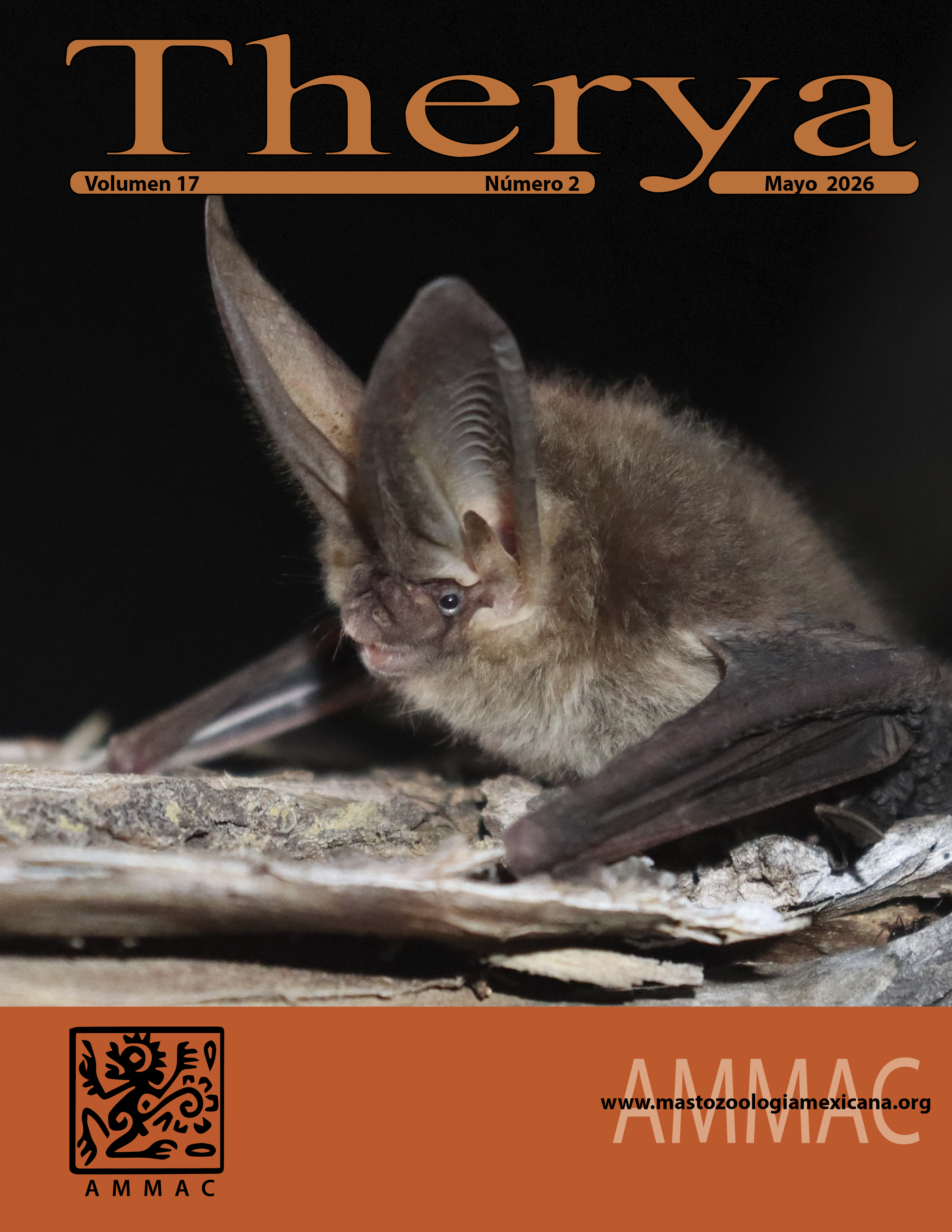
The genus Habromys includes seven species of rodents restricted to Mesoamerican cloud forests across the mountain systems of central and eastern Mexico and northern Central America. Previous studies have suggested that diversification within the genus largely shaped by vicariant scenarios in which range expansion was followed by isolation driven by habitat fragmentation. However, these hypotheses have not been formally evaluated within a time-calibrated framework using explicit model-based approaches. Here, we reconstructed the biogeographic history of Habromys using a time-calibrated phylogeny based on mitochondrial genes, previously used in published studies, and evaluated alternative parametric biogeographic models implemented in BioGeoBEARS. The DEC+j was the best-supported model explaining geographic range evolution, indicating that founder-event speciation and within-area cladogenesis (narrow and subset sympatry) were the most frequent processes shaping diversification, whereas vicariance and anagenetic dispersal/extinction were inferred as comparatively uncommon. Divergence-time estimates suggest that crown diversification in Habromys began during the Pliocene, whereas most interspecific divergences occurred during the middle Pleistocene. These patterns are consistent with a biogeographic history driven by climatic oscillations that periodically increased connectivity among cloud forest habitats and later promoted isolation in montane regions. Overall, our results support a scenario in which repeated colonization and isolation events associated with Pliocene–Pleistocene climatic fluctuations played a greater role than vicariant processes linked to mountain building.
Downloads
Additional Files
Published
How to Cite
Issue
Section
License
THERYA is based on its open access policy allowing free download of the complete contents of the magazine in digital format. It also authorizes the author to place the article in the format published by the magazine on your personal website, or in an open access repository, distribute copies of the article published in electronic or printed format that the author deems appropriate, and reuse part or whole article in own articles or future books, giving the corresponding credits.