Mammals as engines of diversification: revisiting the evolutionary history of the Trypanosoma cruzi clade
DOI:
https://doi.org/10.12933/therya.2026.6270Palabras clave:
bats, Chiroptera, Chagas disease, cophylogeny, host-switching, TrypanosomatidsResumen
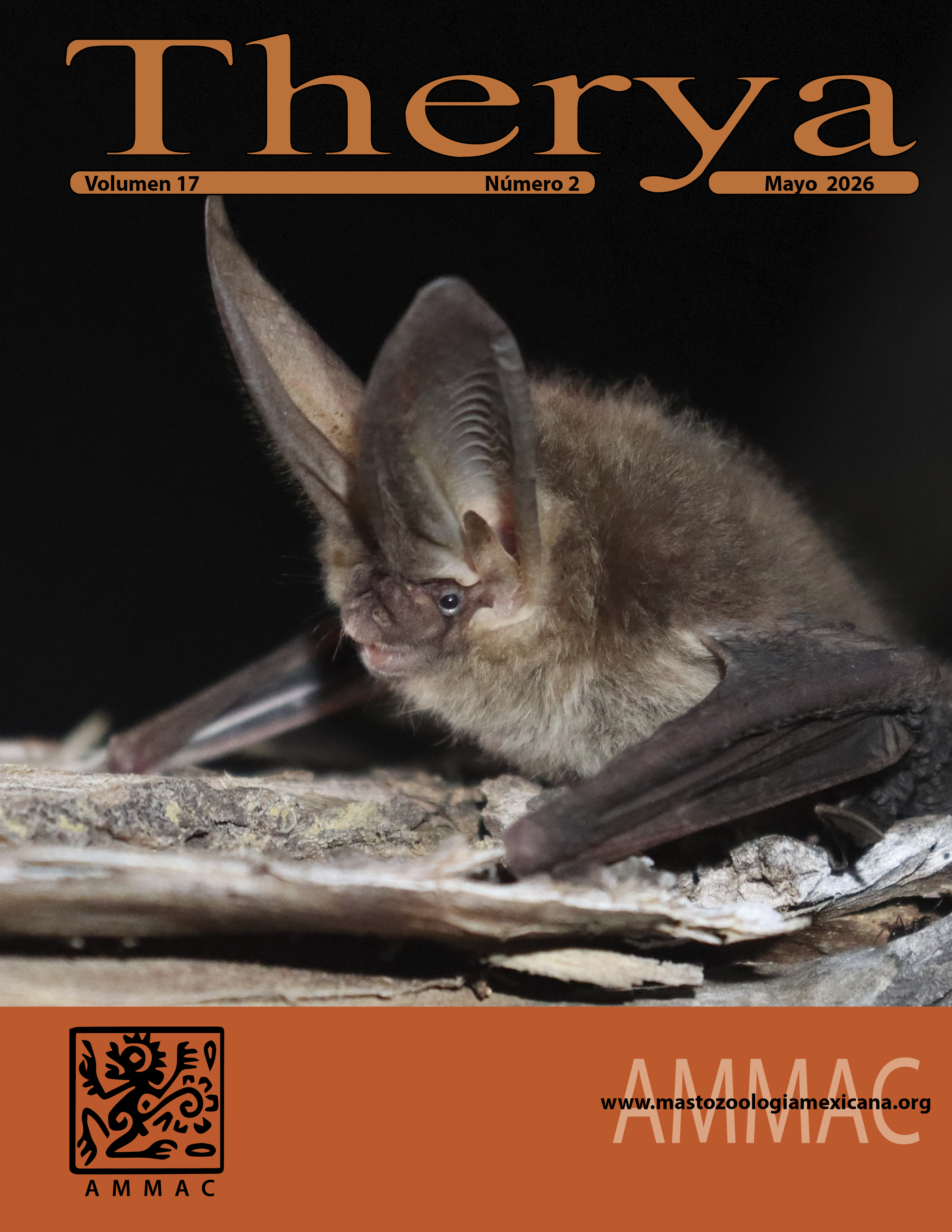
The Trypanosoma cruzi clade represents one of the most complex and ecologically diverse assemblages of mammalian trypanosomes. Although the group’s human pathogenic member T. cruzi is best known as the etiological agent of Chagas disease, its evolutionary origins remain debated. Two main hypotheses attempt to explain the diversification of the T. cruzi clade: the supercontinent hypothesis, which proposes an ancient co-diversification with South American marsupials, and the bat-seeding hypothesis, which suggests a more recent origin through host-switching from bat trypanosomes. Here, we combined parasite and host phylogenies with global-fit cophylogenetic analyses to evaluate whether mammalian diversification has influenced the evolutionary history of the T. cruzi clade. Using PACo and ParaFit, we detected a weak but statistically significant global correspondence between mammal and trypanosome phylogenies. This correspondence was primarily associated with bat-trypanosome relationships, whereas associations involving non-bat mammals showed limited phylogenetic concordance. Together, these findings suggest that mammalian diversification may have influenced trypanosome evolution across multiple evolutionary contexts and timescales.
Descargas
Descargas
Archivos adicionales
- SDT1. Accession numbers of mammalian Cytb sequences used in this study (English)
- SDT2. Accession numbers of trypanosomatid 18S rDNA sequences used in this study (English)
- SDT3. Host–parasite association matrices for cophylogenetic analyses. (English)
- SD1. FASTA-formatted alignment of mammalian Cytb sequences used in this study. (English)
- SD2. FASTA-formatted alignment of trypanosomatid 18S rDNA sequences used in this study. (English)
Publicado
Cómo citar
Número
Sección
Licencia
La revista THERYA, con base en su política de acceso abierto, permite descargar en forma gratuita el contenido completo de la revista en formato digital. También autoriza al autor a colocar el artículo en el formato publicado por la revista en su sitio web personal, o en un repositorio de acceso abierto, distribuir copias del artículo publicado en formato electrónico o impreso a quien él considere conveniente, y reutilizar parte o la totalidad del artículo en sus artículos o libros futuros, dando los créditos correspondientes. Se utiliza la licencia Creative Commons CC BY-NC-SD. La que se especifica en las publicaciones.