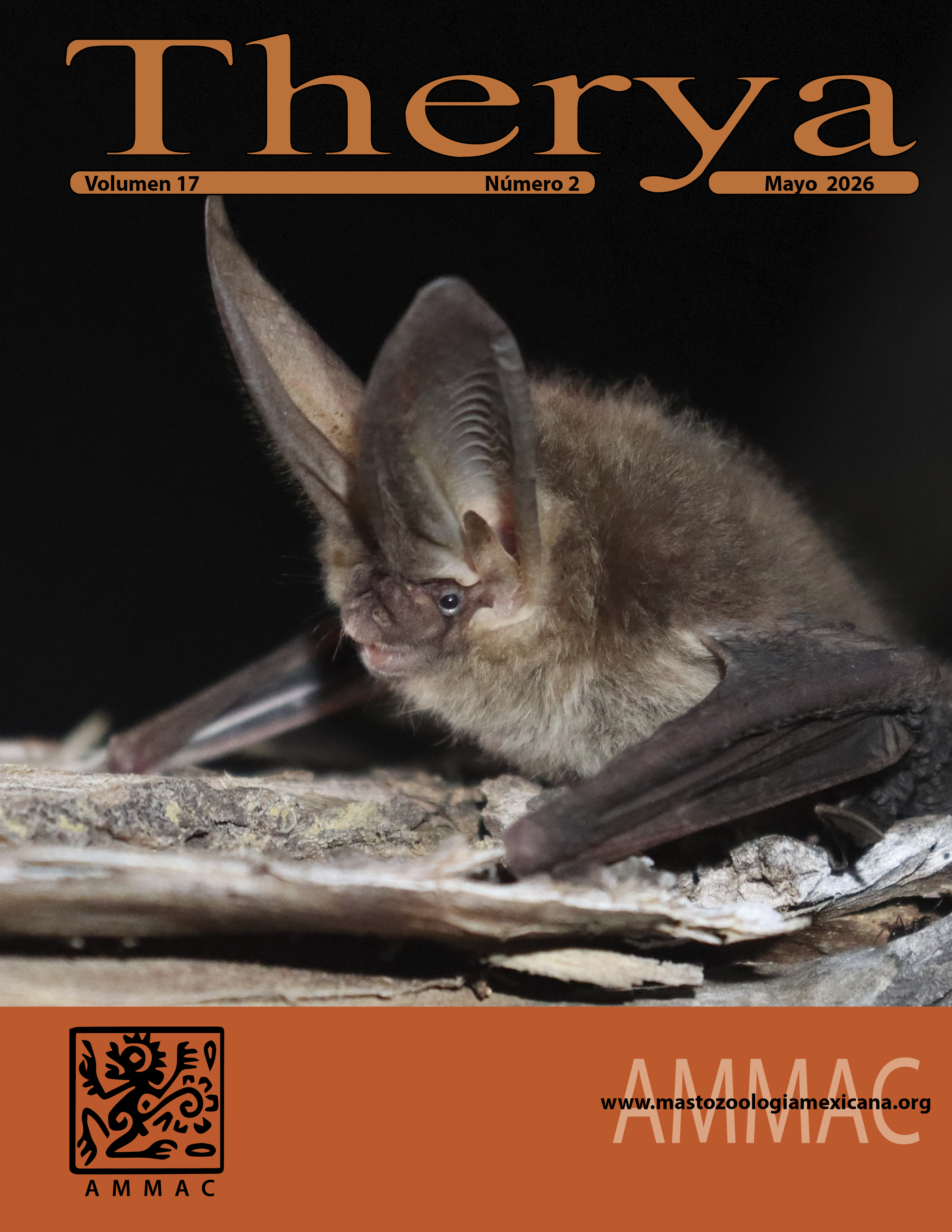
Analyzing the adaptive potential of the long-nosed bat, Leptonycteris nivalis, in the face of climate change
DOI:
https://doi.org/10.12933/therya.2026.6252Keywords:
Chihuahuan Desert, climate change, conservation genomics, Mexico, nectar-feeding bats, potential adaptive, potential distribution, population genomics, SNPAbstract
Tequila or magueyero bats (i.e., the genus Leptonycteris) play a very important role as pollinators in most Mexican and southern US ecosystems, which is why they have recently been given greater attention. Female members of Leptonycteris nivalis populations exhibit migratory behavior associated with nectar consumption and pollination of ecologically important Agave species in Mexico, and with their reproductive events. Such migratory behavior makes them susceptible to the consequences of climate change. In this study, we explored how the distribution and the adaptive potential of L. nivalis may be affected by possible global warming scenarios. We obtained samples from six locations across the distribution of L. nivalis. Using parallel massive-sequencing techniques, we obtained 13,112 filtered SNPs (single-nucleotide polymorphisms). Just two of these SNPs were associated with a climatic variable, but we detected associations between heterozygosity and climate change in two sites. Models of future distribution under climate change indicated a reduction in climatic stable areas favorable to this bat’s presence. Our results will support the implementation of protection strategies for bats and the ecosystems they inhabit, which are the most representative in Mexico. Also, it is very important to maintain connectivity between the localities and refuges occupied by the magueyero bat, as well as to maintain populations within areas of greatest thermodynamic stability, where the most favorable conditions for bat presence are predicted. Based on our analysis, we believe the species has the potential to withstand changes in temperature and precipitation patterns, which may support its conservation.
Downloads
Additional Files
- SD1. Permit to collect biological samples.
- SD2. Pairwise FST values between the sampled locations and Bootstrap values for paired comparisons of FST between sampled locations.
- SD3. CV values for different K values in the admixture analysis.
- SD4. Distance isolation analysis.
- SD5. RONA analysis values for each location.
Published
How to Cite
Issue
Section
License
THERYA is based on its open access policy allowing free download of the complete contents of the magazine in digital format. It also authorizes the author to place the article in the format published by the magazine on your personal website, or in an open access repository, distribute copies of the article published in electronic or printed format that the author deems appropriate, and reuse part or whole article in own articles or future books, giving the corresponding credits.