Evolutionary and environmental influences on cranial shape and forearm length variation in Corynorhinus mexicanus
DOI:
https://doi.org/10.12933/therya.2026.6245Keywords:
Bergmann’s rule, body size, diet, heat conservation, heat dissipation, VespertilionidaeAbstract
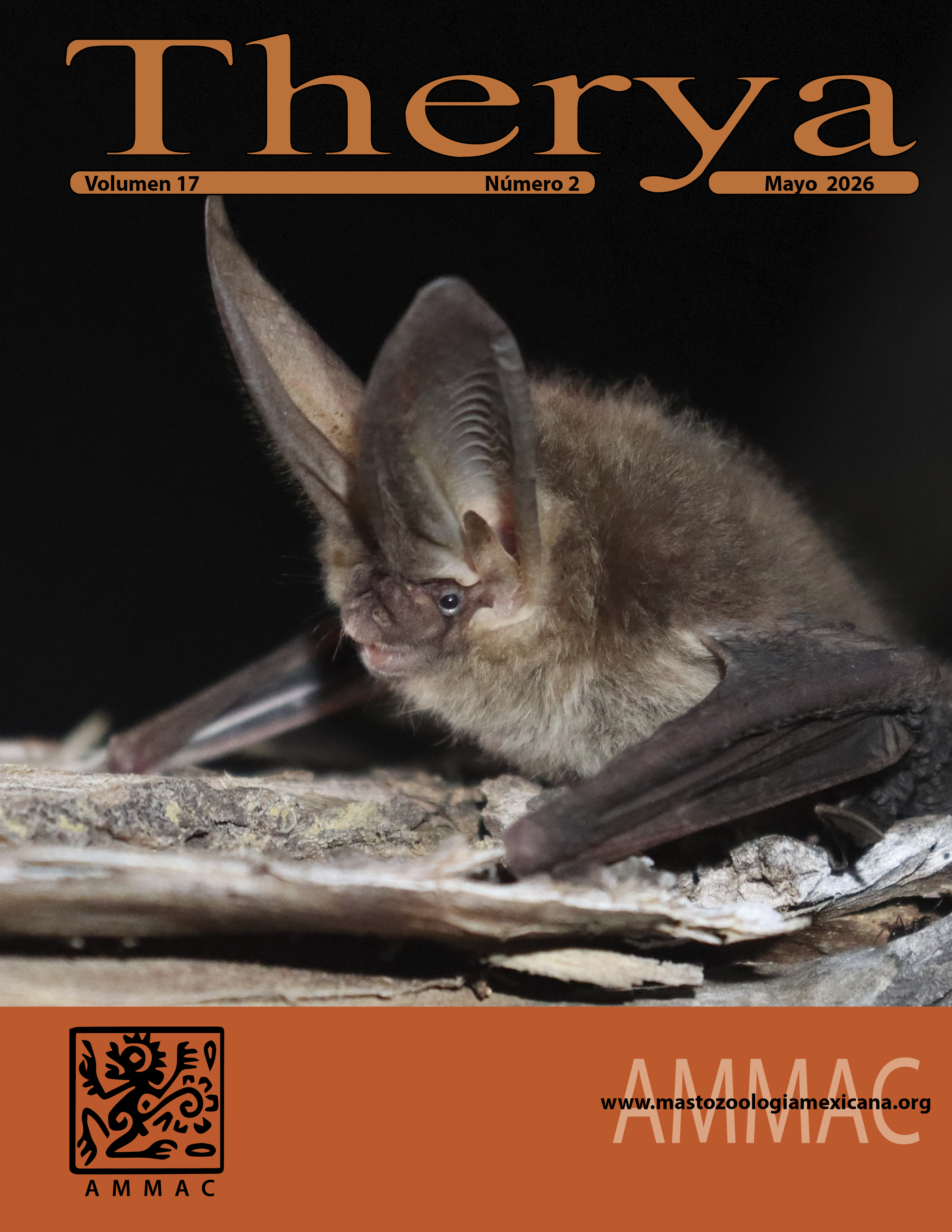
Phenotypic variation in bats reflects the combined influence of environmental and evolutionary factors. Body size often responds to thermal gradients (Bergmann’s rule), whereas cranial and mandibular morphology are often associated with evolutionary history and diet, which are further shaped by resource seasonality. Corynorhinus mexicanus, an endemic bat of Mexico’s temperate forests, was analyzed to assess if environmental factors, evolutionary history, and their interaction influence forearm size and cranial and mandibular shape. Linear mixed models were fitted using forearm measurements and principal components derived from environmental variables, incorporating previously documented intraspecific lineages. Models were compared under annual and monthly temperature variation, accounting for reproductive timing and sex-specific energetic investment. Cranial and mandibular variation were examined using a two-dimensional geometric morphometric protocol to assess the influence of lineage and environmental seasonality as a proxy for dietary composition. Forearm length did not differ between lineages in females but did in males, with those from the Sierra Madre Occidental lineage being smaller. In both sexes, body size followed Bergmann’s rule. Cranial differences between lineages were restricted to the lateral view of the braincase and the ventral view of the rostrum. Overall, cranial variation appeared to be primarily driven by evolutionary history, whereas forearm size reflected a combined influence of evolutionary and environmental factors. Maximum temperatures during the reproductive period influenced forearm length in males, while minimum temperatures affected females. Finally, we highlighted the importance of considering temporal extent and environmental resolution in eco-evolutionary studies.
Downloads
Additional Files
Published
How to Cite
Issue
Section
License
THERYA is based on its open access policy allowing free download of the complete contents of the magazine in digital format. It also authorizes the author to place the article in the format published by the magazine on your personal website, or in an open access repository, distribute copies of the article published in electronic or printed format that the author deems appropriate, and reuse part or whole article in own articles or future books, giving the corresponding credits.